Showing posts with label following Christ. Show all posts

Sunday, May 27, 2012

Starting to Believe

How does one become a "Christian"  - one who is committed to following Christ? Is there some point between not being a Christian and being one, a space of time where the crossover is made?  For some perhaps this happens rapidly, for others more slowly.  But how does it happen?  (Isn't that what we'd really like to know?)

I found something Piper said regarding how one comes to trust in the truth of the Bible to be helpful.    He distinguishes between God "'telling us' that the Bible is true" and "enabling us to see what is really there."  He writes,
The practical effect of this path is that I do not ask you to pray for a special whisper from God to decide if Jesus is real.  Rather I ask you to look at the Jesus of the Bible.  Look at him.  Don't close your eyes and hope for a word of confirmation.  Keep your eyes open and fill them with the full portrait of Jesus provided in the Bible.  If you come to trust Jesus Christ as Lord and God, it will be because you see in him a divine glory ad excellence that simply is what it is - true. (Seeing and Savoring Jesus Christ, p.121)
This does not diminish the work of the Holy Spirit, who helps us see this truth.  It does speak against the idea that we should pray for some sign or magical change in ourselves that will make us all of a sudden believe in something that a logical person would find unbelievable.  You don't trust and follow someone unless you know them; you don't know them unless you take the opportunities to do so.

art credit:http://www.omsc.org/art-at-omsc/huibing/jesus-opens-eyes-slide.html
This applies to those of us who already profess to follow Christ.  Are we truly looking at Christ, and expecting to see ever more?  The Holy Spirit does the work of helping us see, but do we allow Him to do so?  This is a challenge to me to really hunger to know Christ more.

Does this resonate with you?  Is what Piper says helpful?

Thursday, April 05, 2012

Maundy Thursday?

This morning as I got ready for the day, I asked myself, what on earth does "Maundy" mean?  And what does it have to do with the account I read today in the gospels of what happened on this day?  I did some quick research, the results of which, for the sake of those who like me are sadly ignorant in these matters, I will share.

Monday, April 02, 2012

Shouting Stones


"...the whole crowd of disciples began joyfully to praise God in loud voices for all the miracles they had seen:
  “Blessed is the king who comes in the name of the Lord!”
   “Peace in heaven and glory in the highest!”
  Some of the Pharisees in the crowd said to Jesus, “Teacher, rebuke your disciples!”
    “I tell you,” he replied, “if they keep quiet, the stones will cry out.” (Luke 19:37-40)

This is a strange thing for Jesus to say with such conviction.  What does it mean? As I meditate on it, I see two things and a question:

Monday, July 04, 2011

Contentment II

Here in North America, it is a weekend of celebration: Canada Day, Independence Day - we celebrate our nations, and the freedoms and good things that come as being part of these nations.  It is thus somewhat ironic and yet also somewhat fitting that the passage I am about to quote is not about celebrating human achievement, but rather about realizing that it is not the important thing.

I have been learning a lot about contentment lately, and this quotation really struck home.  We all know how futile it is to pursue "the american dream", but do we really live in that knowledge?  Here is the prayer of Thomas Merton:
Why should I want to be rich, when You were poor?  Why should I desire to be famous and powerful in the eyes of men, when the sons of those who exalted the false prophets and stoned the true rejected You and nailed You to the Cross?  Why should I cherish in my heart a hope that devours me-- the hope for perfect happiness in this life -- when such hope , doomed to frustration, is nothing but despair?  
My hope is in what the eye has never seen.  Therefore, let me not trust in visible rewards. My hope is in what the heart of man cannot feel.  Therefore let me not trust int he feelings of my heart.  My hope is in what the hand of man has never touched.  Do not let me trust what I can grasp between my fingers.  Death will loosen my grasp and my vain hope will be gone. 
Let my trust be in Your mercy, not in myself.  Let my hope be in Your love, not in health, or strength, or ability or human resources.
(From Thoughts in Solitude by Thomas Merton)
In the middle paragraph, it is helpful to note that while God has revealed himself to us in tangible, physical, ways, and while we do hope for a physical reality in the resurrection of the dead and the restoration of all things, our hopes are in so much more than what our mind can conceive of now; they are so much more than the things after which our generation chases.   Our focus and our hope and our life must be based on Christ, and Christ alone.

Monday, July 05, 2010

the most incredible event

I've been reading the Message paraphrase, and have been struck anew by certain passages. Paul's argument for the necessity of believing the resurrection in 1 Corinthians 15 is powerful. Even though I claim this to be true (every time I say the creed, for example) Paul's words challenge us to consider how this affects the way we think about and live our lives. I have selected portions of the passage (it is somewhat lengthy) below for you to read and consider as well.

Resurrection

Friends, let me go over the Message with you one final time [...]

The first thing I did was place before you what was placed so emphatically before me: that the Messiah died for our sins, exactly as Scripture tells it; that he was buried; that he was raised from death on the third day, again exactly as Scripture says; that he presented himself alive to Peter, then to his closest followers, and later to more than five hundred of his followers all at the same time, most of them still around (although a few have since died); that he then spent time with James and the rest of those he commissioned to represent him; and that he finally presented himself alive to me. It was fitting that I bring up the rear. I don't deserve to be included in that inner circle, as you well know, having spent all those early years trying my best to stamp God's church right out of existence.

But because God was so gracious, so very generous, here I am. [...]

Now, let me ask you something profound yet troubling. If you became believers because you trusted the proclamation that Christ is alive, risen from the dead, how can you let people say that there is no such thing as a resurrection? If there's no resurrection, there's no living Christ. And face it—if there's no resurrection for Christ, everything we've told you is smoke and mirrors, and everything you've staked your life on is smoke and mirrors. Not only that, but we would be guilty of telling a string of barefaced lies about God, all these affidavits we passed on to you verifying that God raised up Christ—sheer fabrications, if there's no resurrection.

If corpses can't be raised, then Christ wasn't, because he was indeed dead. And if Christ weren't raised, then all you're doing is wandering about in the dark, as lost as ever. It's even worse for those who died hoping in Christ and resurrection, because they're already in their graves. If all we get out of Christ is a little inspiration for a few short years, we're a pretty sorry lot. But the truth is that Christ has been raised up, the first in a long legacy of those who are going to leave the cemeteries.

There is a nice symmetry in this: Death initially came by a man, and resurrection from death came by a man. Everybody dies in Adam; everybody comes alive in Christ. But we have to wait our turn: Christ is first, then those with him at his Coming, the grand consummation when, after crushing the opposition, he hands over his kingdom to God the Father. He won't let up until the last enemy is down—and the very last enemy is death! As the psalmist said, "He laid them low, one and all; he walked all over them." When Scripture says that "he walked all over them," it's obvious that he couldn't at the same time be walked on. When everything and everyone is finally under God's rule, the Son will step down, taking his place with everyone else, showing that God's rule is absolutely comprehensive—a perfect ending!

[...]

And why do you think I keep risking my neck in this dangerous work? I look death in the face practically every day I live. Do you think I'd do this if I wasn't convinced of your resurrection and mine as guaranteed by the resurrected Messiah Jesus? Do you think I was just trying to act heroic when I fought the wild beasts at Ephesus, hoping it wouldn't be the end of me? Not on your life! It's resurrection, resurrection, always resurrection, that undergirds what I do and say, the way I live. If there's no resurrection, "We eat, we drink, the next day we die," and that's all there is to it. But don't fool yourselves. Don't let yourselves be poisoned by this anti-resurrection loose talk. "Bad company ruins good manners."

Think straight. Awaken to the holiness of life. No more playing fast and loose with resurrection facts. Ignorance of God is a luxury you can't afford in times like these. Aren't you embarrassed that you've let this kind of thing go on as long as you have?

Some skeptic is sure to ask, "Show me how resurrection works. Give me a diagram; draw me a picture. What does this 'resurrection body' look like?" If you look at this question closely, you realize how absurd it is. There are no diagrams for this kind of thing. We do have a parallel experience in gardening. You plant a "dead" seed; soon there is a flourishing plant. There is no visual likeness between seed and plant. You could never guess what a tomato would look like by looking at a tomato seed. What we plant in the soil and what grows out of it don't look anything alike. The dead body that we bury in the ground and the resurrection body that comes from it will be dramatically different.

[...]

This image of planting a dead seed and raising a live plant is a mere sketch at best, but perhaps it will help in approaching the mystery of the resurrection body—but only if you keep in mind that when we're raised, we're raised for good, alive forever! The corpse that's planted is no beauty, but when it's raised, it's glorious. Put in the ground weak, it comes up powerful. The seed sown is natural; the seed grown is supernatural—same seed, same body, but what a difference from when it goes down in physical mortality to when it is raised up in spiritual immortality!

[...]

I need to emphasize, friends, that our natural, earthy lives don't in themselves lead us by their very nature into the kingdom of God. Their very "nature" is to die, so how could they "naturally" end up in the Life kingdom?

But let me tell you something wonderful, a mystery I'll probably never fully understand. We're not all going to die—but we are all going to be changed. You hear a blast to end all blasts from a trumpet, and in the time that you look up and blink your eyes—it's over. On signal from that trumpet from heaven, the dead will be up and out of their graves, beyond the reach of death, never to die again. At the same moment and in the same way, we'll all be changed. In the resurrection scheme of things, this has to happen: everything perishable taken off the shelves and replaced by the imperishable, this mortal replaced by the immortal. Then the saying will come true:

Death swallowed by triumphant Life!
Who got the last word, oh, Death?
Oh, Death, who's afraid of you now?

It was sin that made death so frightening and law-code guilt that gave sin its leverage, its destructive power. But now in a single victorious stroke of Life, all three—sin, guilt, death—are gone, the gift of our Master, Jesus Christ. Thank God!

With all this going for us, my dear, dear friends, stand your ground. And don't hold back. Throw yourselves into the work of the Master, confident that nothing you do for him is a waste of time or effort.

Sunday, February 28, 2010

The mind is a funny thing. I have in my head all these thoughts - good candidates for something which you might find interesting to read - and yet they refuse to make themselves into a coherent whole. Perhaps it is just because I am tired. To solve this problem I have decided to let you do the work by asking questions.

The winter Olympics have just finished. What can we learn from them? Is such an event given too much attention, given everything else going on around the world?

What is the significance of winning a medal at the Olympics? Is that the primary goal of all the athletes?

On Friday I heard a good talk on one of my favourite passages:
Therefore, since we are surrounded by such a great cloud of witnesses, let us throw off everything that hinders and the sin that so easily entangles, and let us run with perseverance the race marked out for us. Let us fix our eyes on Jesus, the author and perfecter of our faith, who for the joy set before him endured the cross, scorning its shame, and sat down at the right hand of the throne of God. Consider him who endured such opposition from sinful men, so that you will not grow weary and lose heart. (Heb 12:1-3)
Writing from a cultural context not so different from our own, Paul uses sports images. This is a challenge to pursue a life of endurance and wholehearted focus, to run "the race marked out for us" with everything we have. In what ways is our 'race' similar and different from those of the Olympians?

The biggest challenge to me is throwing off "everything that hinders". What is hindering you?

Sunday, January 31, 2010

is Christian faith a religion?

religion (Definition from Merriam-webster)
(1) : the service and worship of God or the supernatural (2) : commitment or devotion to religious faith or observance
2 : a personal set or institutionalized system of religious attitudes, beliefs, and practices
3 archaic : scrupulous conformity : conscientiousness
4 : a cause, principle, or system of beliefs held to with ardor and faith

I was just reading Willard's book, Knowing Christ today, and was struck by the following (read the bold- the rest is given for context if you're interested):
Jesus comes through in spite of everything. The most profound critic of society and the "masks", Christian or otherwise, is Jesus himself. In this respect he stands in the line of the sharp-tongued Hebrew prophets and brings it to completion. Berger finds that "the crucial point of the relationship between Christian faith and the antireligious critique is to be found in a theological proposition. The proposition states that the revelation of God in Jesus Christ (which is the object of Christian faith) is something very different from religion." Religion has many critics, but Jesus has few. He is a self-authenticating reality beyond the myriad of social cocoons. He belongs to humanity. He called himself "Son of Man."
... Christ transcends all social visions and all entanglements with religion.
In him God breaks through. "Christian faith is not religion," Berger affirms. That is the scalding truth of the matter. Suddenly from under the smothering panoply of human visions there emerges an outbreak of realism - a little breath of something that promises to interrupt and stand in judgment upon all our enculturated "visions" and their possible "alterations" of one into another. It is the Jesus of "all nations", of "all ethnic groups," of all kinds of people, of "whosoever will" -- of the last who are first and the first who are last in human orders. He is the light that gives light to everyone who is in the world. (p146)
Christianity is not simply a human endeavor- not something we have done - it is the response to what God has done. (and continues to do!) It's not that I don't think the church is important. Rather I think that in some way this (the reason for the church in the first place) is really good news for the church. This is a living God we worship, in ongoing creative activity, challenging and transforming us and our tangled up society. As usual I find myself back at the incarnation, my wonder and fear and love deepening each time I understand more of this Jesus I have chosen to follow.

What do you think?
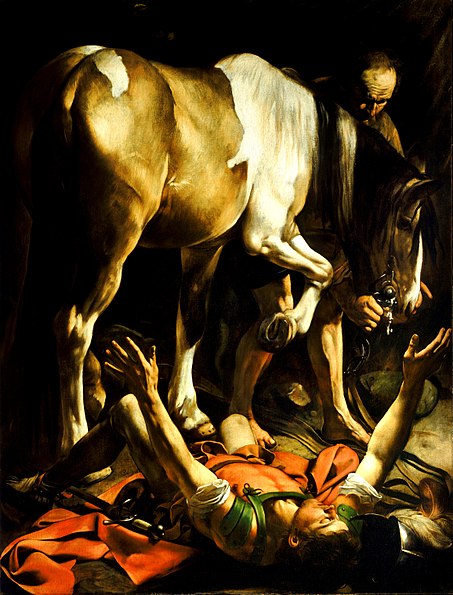
Caravaggio, The Conversion on the Way to Damascus (1601) (see Acts 9:1-18)

Sunday, October 04, 2009

Morning in an Abbey

Today I attended mass at the Abbey of the Genesee. The life of the Cistercian, or Trappist, monks intrigues me and causes me to reflect on the nature of the church and individual callings.

I spent some time on their website, trying to understand a bit about them. They are a "a monastic institute wholly ordered to contemplation". To this end they devote themselves to silence, solitude, prayer, etc. Entry into the community is note something to be taken lightly, and the process takes years. Near the end of a description of this process, the site notes that
The primary responsibility of the newly professed monk is to love with all his heart. The vows presuppose this love and express it exteriorly by incorporating him into a state of life which has no other reason for existence than the love of Christ and all that implies.
This is in many ways an attractive way of life to those who strive daily to turn all the loves of our heart toward Christ, amidst the noisy and busy world of ordinary life.

Yet... I am still left with some questions, which I will note here before ending this brief post:
  • What is the role of these communities within the church?
  • All followers of Christ are his disciples in different ways. However, do those who choose such a specific vocation find themselves limited in the ways they can obey and imitate Christ? For example, how do they share the good news when they are so hidden from the world?
  • Are there certain times in the cultural and historical climate for which this way of following Christ is more or less appropriate?

Sunday, July 19, 2009

A Christian and a Scientist?

A question has increasingly been taking on personal significance to me: what motivates a follower of Christ to work in the field of science? Is there some disconnect, or does one flow naturally with the other?

An answer most easily offered is that science benefits people. Those who pray, "thy kingdom come" are motivated to be a part of changing our world for the better. Most advances in medicine and other areas which aid people have been inextricably linked to scientific progress. Yet this statement cannot go the other way. All advances in science did not lead to the aid of humanity. Nuclear medicine developed alongside nuclear weapons. Even excepting that rather negative view, I find this answer rather far-fetched. Belief in the abstract ability of science to benefit people in the future does not seem like motivation enough to go back to the lab each day.

Another possible motivation is simply the sheer delight in the natural world as the invention of an incredibly creative and intelligent God. There is a fine line here. The Christian scientist does not merely love the created world, for that would be idolatry. He or she loves the exploration of the natural world because it enables them to see just a bit more clearly how beautiful and awesome is the God who made it. Piper has pointed out that God is glorified when his people delight in him. I agree, and find this answer much more plausible than the first.

Yet I am still troubled by this: the God revealed in the bible is not only a creative and majestic and awesome God; he is also the God who brings good news to the poor and justice to the oppressed. It seems to me that any follower of Christ, including the scientist, must also care about this. So what does this mean for the Christian scientist, or for anyone whose vocation does not directly help the poor or oppressed? I can suggest three possible answers to this question:
  1. We have to remember that we are not the only member of the church, and trust God that he uses many different people to work in myriads of ways. Surely our creative God does not need to limit all of his people to the same type of vocation. This may be true, but is it a satisfying answer?
  2. Science is only done with part of our lives; the rest of the time is also valuable time in which God can use us in other ways. Unless my second "answer" above is true, this point makes almost no sense. Even so, it stands on shaky ground. If the scientist can best glorify God by doing science, then why worry about doing anything else? On the other hand, if it is the evenings and weekends that really make a difference in God's kingdom, why bother doing working in the lab in the first place?
  3. There is a way of living that glorifies God and brings his kingdom on earth that is not limited by a career in science. Perhaps in one small but important sense, it doesn't really matter what career we choose. I am not saying our actions are meaningless. On the contrary, it is what we do all the time - the things we say, the way we interact with people, our priorities, the way that we praise God through our work - these are the things that matter. Surely God could provide opportunities to bring freedom and comfort and justice to those who need it, right in the midst of a scientific vocation.
I am still far from being comfortable with any of these answers. In the meantime, I am going to continue to delight in God, and to trust him in his incredible creativity and wisdom.

Sunday, May 31, 2009

Radical Christian: a Redundancy?

Thoughts while reading "Everything Must Change" by Brian McLaren

Often when I return home I discover that a new interesting book has appeared in the house, usually as one of my dad's current reads. This time I decided to read Everything Must Change by Brian McLaren.

I have been rather disappointed by this book so far. One frustrating part is my question of who he thinks "conventional Christians", as he dubs them, really are. Linked to this is my question of audience. In chapter 10 he contrasts the "conventional" and "emerging" views by summarizing the gospel from the two perspectives. The words he puts into the mouths of the "conventional" Christians are often mocking. He essentially says they reduce the gospel into some sort of platonic but personal thing which "produces a happier life" and saves the sinner from hell. This is of course contrasted to the "emergent" view, which allows for a much fuller reading of the whole bible.

Merriam-Webster defines conventional as "formed by agreement or compact". I think most theologians and Christian thinkers would disagree with McLaren's summary of the conventional views. Doesn't this make them unconventional? Perhaps McLaren should have said "popular"?

Word choice aside, all this talk confuses me about his audience. I have three questions: 1) If McLaren is writing to "conventional" Christians (assuming such people do exist), why insult them? 2) Would such people care enough to read all 300 pages of his book in the first place? 3) If he is not writing to these people, but instead writing to those who really do want to understand the working of God and of the church in our hurting world now, in the present, what purpose does such a sloppy (in my view) comparison serve?

It seems that McLaren is trying to show how radically different this "emerging" view is. The trouble is, all my experience so far shows me that the bible itself is a radical book. Anyone who has read the gospels recently will tell you that. For centuries, people in the church have understood this. St. Francis stripped off all his clothes to reject worldly values and then he preached to the birds (among other things). Corrie Ten Boon and many others like her forgave. Many have given their lives in service to the poor. C.S. Lewis said Aslan is not a tame lion. God is not tame, and most of those who follow at some cost him have found this out.

Yes, the good news is about personal salvation through Christ's death on the cross. But anyone who has been reading their bible can tell you that it is about so much more! Jesus himself claimed part of God's mission "of good news to the poor", to bring "freedom for the prisoners and recovery of sight for the blind and to set the oppressed free" (Luke 4:18) And that is just the beginning. I think McLaren is saying all this. I just don't think that what he is saying is as new and different as he is suggesting.

I realize have given a rather negative impression. I am convinced he does have some worthwhile things to say even if I don't always agree with his views or method, so I will continue reading and hopefully give a better report in the near future.

Sunday, March 01, 2009

"Time is our Currency"


For some time I've been wanting to write a reflection about the use of the book of hours, and a couple things I learned this week make this the ideal time to do so.

The keeping of the hours originally arose out of the Jewish tradition of praying at set times of the day. The first Christians, who were often Jews as well, naturally incorporated this practice into their prayer lives. For example, it is interesting to note that when Peter had the vision about eating the Gentile's food on the rooftop, he had gone there to observe the sixth hour prayers.

These regular prayers throughout the day developed in the Middle Ages into the complex and lengthy prayers used in the monasteries. These were modified and shortened for use by laity and eventually we have the form used by many today, consisting of four hours, or offices: morning, midday, vespers, and compline.

I have had the opportunity, since Advent, to use a book of hours which lays out these prayers in an easy format, allowing me to have beautiful prayers to assist me in prayer four times a day. I have learned much - perhaps I should say convicted of much - from these prayers. Firstly, the use of liturgy for prayer is something I'd like to discuss in further detail in a later post. More to the topic, I have found that despite the fact that each office only takes 5-10 minutes, it has been it surprisingly hard to stop whatever I'm doing and find a quiet place to pray. Even if I'm working on something by myself, it is easy to push it off. Why is this the case? If I love spending time with God, how can prayer possibly become a chore, a bother?

Donald Miller, in his book Blue Like Jazz (which I read this week), tells asking a man he saw serving each day how he did it - didn't he loose patience, cleaning up after everyone else? The man answered, wisely, "If we are not willing to wake up in the morning and die to our selves, perhaps we should ask ourselves whether or not we are really following Jesus." I confess that this really convicted me.

I realized that the biggest way I am unwilling to die to myself is with my time. Chris Rice, in his song "Life Means So Much", says "Time is our currency". In many ways, especially for us college students, I think this is so true. And it is something I cling to, thinking that it is something I own. As I wrote on Jan 25, time is wonderfully complex. But more importantly: unless I am willing to give it up to serve, I cannot truly follow Christ. I know I'll be leaning heavily on his grace and mercy as I seek change in this area of my life.

History taken from The Divine Hours, by Phyllis Tickle.
Picture: Book of Hours, Paris. Circa 1460-1465. Picture taken from http://www.library.usyd.edu.